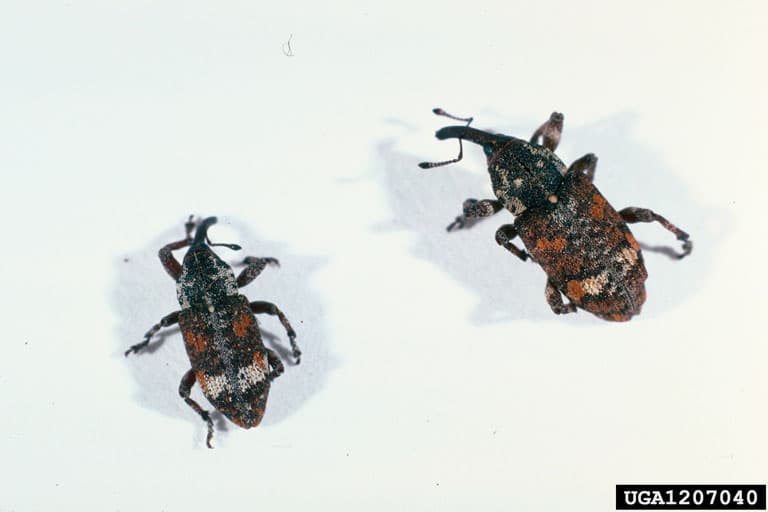
White Pine Weevil
Pissodes strobi
A small snout beetle whose larvae kill the topmost shoot of white pine, spruce, and other conifers, producing a wilted, drooping leader shaped like a shepherds crook. Repeated attacks leave trees crooked and bushy.
🔎 How to spot it
Adults are brown snout beetles about a quarter inch long with patches of white and gold scales on the wing covers and a white patch at the tip. The larvae are white, legless, C-shaped grubs with brown heads. The classic sign is the previous-year leader wilting into a curled shepherds crook in early summer, with tiny sap droplets on the terminal in spring.
🥀 Damage it causes
In spring, adults feed on the terminal leader and lay eggs in it, and the larvae then feed in a ring around the leader, cutting off nutrients and moisture so the top wilts and dies. Side branches turn up to replace the dead leader, leaving a forked or crooked, bushy tree. The leader of the previous season is the part that is killed.
🛡️ Prevent it
Where practical, plant in partial shade, which lowers terminal temperatures and reduces attack. Prune out and destroy wilted, infested leaders as soon as wilting appears but before adults emerge in mid-July, cutting only as far down as needed, and train a single side branch up as a new leader. Remove unmanaged host trees that act as reservoirs.
🧯 If it is already here
Spray the top third of the tree when adults first become active in spring, generally April into May as ground temperatures warm, since delaying treatment gives poor control. Monitor with traps or by watching for sap droplets to time the application. Removing infested leaders before adults emerge also reduces next years population.
💡 Good to know
There is one generation a year, and adults overwinter in litter under the trees, becoming active when ground temperatures rise above about fifty degrees. Eastern white pine and Norway and other spruces are favored hosts. Side branches replacing the killed leader are what cause the long-term crook and fork defects.
🌱 Plants it attacks
5 plants in the library can be attacked by this pest


For educational and informational purposes only. Pest control advice is general guidance drawn from university cooperative extension sources; always identify a pest positively and read and follow the label on any product before use, especially around food crops, children, and pets.