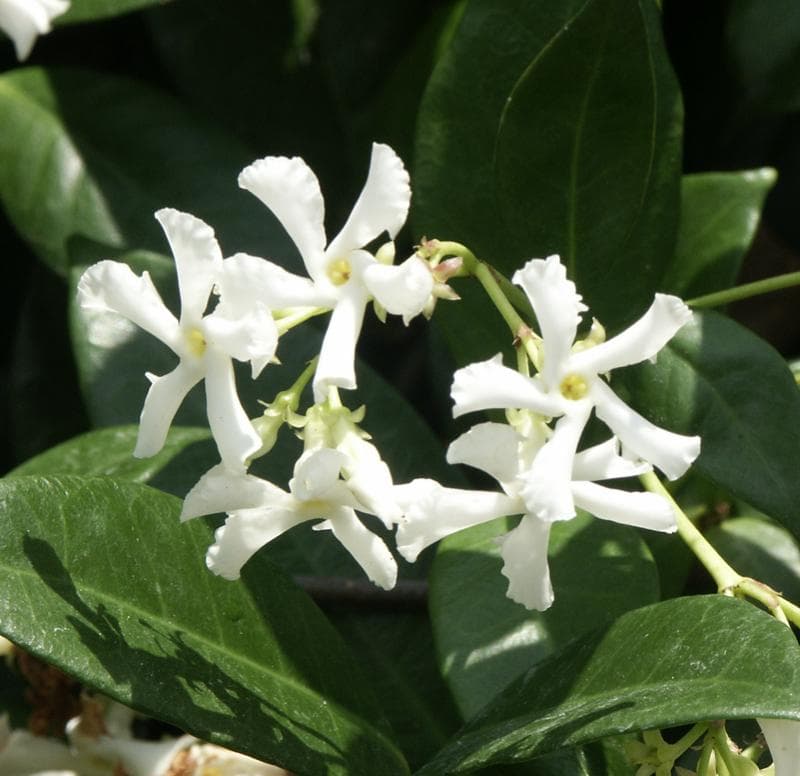
Star Jasmine
Trachelospermum jasminoides
flowerStar jasmine (Trachelospermum jasminoides), also called Confederate jasmine, is an evergreen twining vine grown throughout the South for glossy, dark green leaves and, in late spring, masses of small, creamy-white, pinwheel-shaped flowers with a rich, sweet, jasmine-like fragrance. Despite the name it is not a true jasmine. Trained to a support it climbs 3 to 20 ft; left on the ground it makes a dense, sprawling groundcover. It is evergreen and handsome year-round in mild climates.
☀️
Sun
full sun
💧
Water
Every 6 days
🌸
Bloom
~60 days
📊
Difficulty
easy
🌱
Lifecycle
tender perennial
Perennial in warm zones; grown as an annual where winters freeze
↔️
Spacing
3-6 ft apart
⬇️
Planting Depth
Set at the same depth as the nursery pot
🧪
Soil pH
6.0-7.0
Growing Details
Soil Type
Loamy, well-drained
Hardiness Zones
Zones 8 – 10
When to Fertilize
Light feeding in spring
Fertilizer
Balanced general-purpose fertilizer
🌱 Growing Guide
Plant star jasmine in full sun to partial shade in loamy, well-drained soil; more sun means more flowers and a denser plant. It is hardy in zones 8 to 10 and needs a frost-free or nearly frost-free climate, though it can be grown in a container and sheltered in colder areas. Provide a trellis, fence, or wires for the twining stems to climb, or let it spread as a groundcover. Water to establish, then it is moderately drought tolerant. Prune right after the main flush of bloom to keep it within bounds, cleaning the sticky sap from your tools afterward.
🌼 Have a different variety?Cultivars of the same species usually share the same basic care, and they differ mainly in flower color, height, and bloom form, not in how you grow them. So this guide still applies even if your exact variety isn't the one shown.
Planting Calendar
Sign in to personalize →🌿
Direct sow
Apr 15
🌸
Projected first bloom
Jun 14
JJan
FFeb
MMar
AApr
MMay
JJun
JJul
AAug
SSep
OOct
NNov
DDec
✅ Plant alongside
Good neighbors that attract beneficial insects or deter pests
- Clematis: A flowering vine that can share a structure for a longer bloom season
- Climbing Rose: Pairs on an arbor or fence with complementary fragrance and bloom
- Camellia: A Southern evergreen shrub that suits the same mild-climate setting
🛡️ Pest & disease prevention
Proactive ways to stop trouble before it starts. Tap a name with an arrow for its full guide
Skeletonize leaves in early summer; hand-pick in the cool morning and support plant vigor
Bumps on stems with sticky honeydew; prune out heavy infestations and conserve natural enemies
Black film growing on honeydew; control the sap-feeders beneath it and rinse foliage
🌸 Blooms & cutting
Star jasmine is grown for fragrance and evergreen cover, not harvest. Prune it right after the main late-spring bloom to shape it and keep it in its space, since flowering is on growth from the previous season. Wear gloves and clean the milky sap from pruners afterward. A few flowering sprigs can scent a room.
🥗 Nutrition & benefits
Star jasmine is an ornamental, not edible. Its value is glossy evergreen foliage, an intoxicating late-spring fragrance, and versatility as a vine or groundcover in mild climates, with nectar for pollinators. Have a different variety? Cultivars of the same species share the same basic care, so this guide still applies even if your exact form is not shown.
⚠️ Toxicity & safety
Star jasmine is in the dogbane family and bleeds a white milky latex from cut stems and leaves that is considered mildly poisonous and can irritate skin. Clean tools and wash hands after pruning, and keep pets from chewing the foliage; it is grown as an ornamental, not for eating.
For educational and informational purposes only. HomeSown is not medical, health, or other professional advice. Always positively identify any plant before handling or eating it; some plants, and some parts of otherwise-edible plants, are toxic. Consult a qualified professional before consuming or otherwise using any plant, especially if you are pregnant, nursing, taking medication, or have a health condition.